
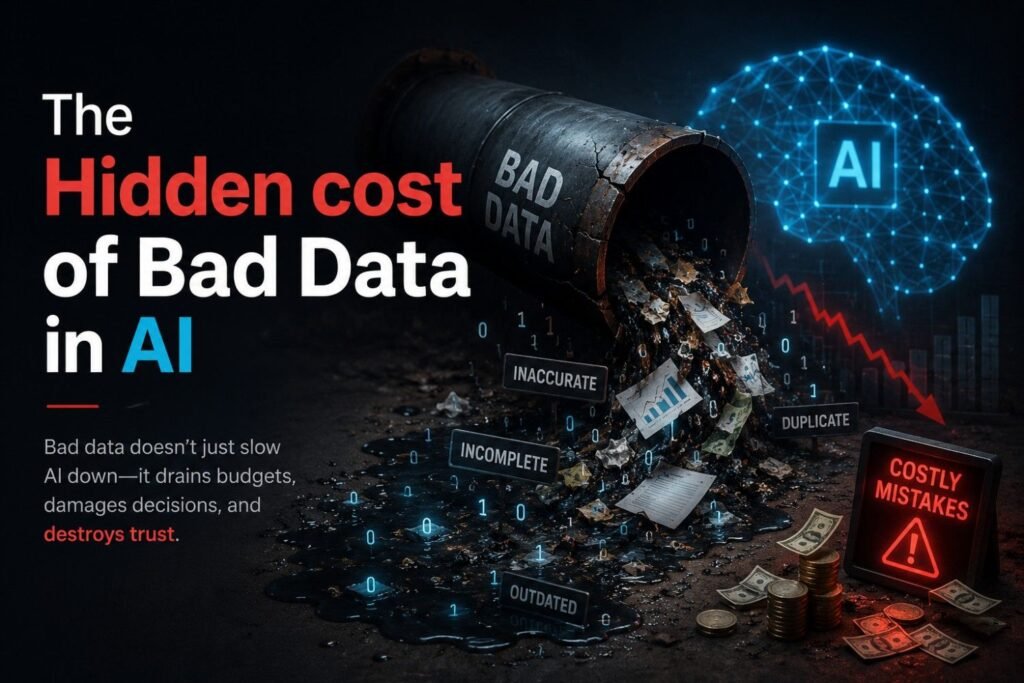
More Data Doesn't Mean Better AI
There is a seductive logic that has taken hold in boardrooms around the world: the more data you have, the smarter your AI will be. It sounds reasonable. It feels safe. And it is almost completely wrong.
The scramble to accumulate data, acquiring companies for their databases, building vast data lakes, and investing heavily in IT infrastructure on the vague promise that it will be useful for AI one day, has quietly become one of the most expensive mistakes in modern business. This article is about why that is, and what to do instead.
1. More Data Is Not Necessarily Good Data
Volume and value are not the same thing. Organisations that have been collecting data for decades often assume their accumulated years of records, logs, and transactions represent a goldmine waiting to be unlocked by AI. Sometimes that is true. Very often, it is not.
Data degrades. Formats change. Business processes evolve, making historical records structurally incompatible with current ones. Customer records contain duplicates, errors, and gaps. Sensor logs from old equipment measure things that no longer matter. The sheer weight of it all can actually make the problem worse, burying the genuinely useful signal beneath mountains of noise.
2. You Can't Just Throw Data at Your AI Team
Handing your AI team a hard drive full of data and calling it a day is not a data strategy. It is a delegation of confusion. The assumption that data scientists will somehow figure out what is valuable, usable, and what the business actually needs, places an unfair and ultimately unproductive burden on the wrong people.
Data scientists are not archaeologists. Their job is to build models that solve specific problems, not to sift through decades of organisational history hoping to find something useful. When forced to do the latter, timelines stretch, costs balloon, and the models they eventually build are shaped more by what data happened to be available than by what data would actually make the model good.
3. The Real-World Cost of Buying Data You Can't Use
Some of the most instructive lessons in data strategy have come from expensive acquisitions that never delivered their promise.
These are not stories about bad intentions or poor execution in isolation. They are stories about a fundamental mismatch between the data that was acquired and the AI that was expected to emerge from it. Data assets must be stress-tested against the AI use cases they are supposed to enable, before the investment is made.
4. Let Your AI Team Look at the Data First
The most valuable thing an AI team can do before a single model is trained is to audit your existing data, not to start building, but to guide the entire organisation on what data actually matters.
This means engaging your data scientists and ML engineers early in strategic conversations, not just at the implementation stage. Ask them:
- What data do we currently have that is genuinely relevant to the problems we want to solve?
- Which datasets are clean and reliable enough for AI training, and which require major remediation?
- Where are the critical gaps - what data is still missing for the AI systems we aim to build?
- Are there existing datasets that could create immediate value through simpler AI models and quick wins?
This kind of upfront assessment does not slow down AI development. It is what makes AI development possible. Teams that skip it spend months building on foundations that later prove unreliable.
5. Garbage In, Garbage Out - More Relevant Than Ever
The principle is old. The implications have never been larger or more commercially significant.
In classical software, bad data produces bad outputs that are usually obviously wrong. A report with corrupted figures looks broken. A database with duplicate entries throws an error. The failure is visible.
In AI, the failure is frequently invisible. A model trained on bad data does not crash, it learns. It learns the wrong things, with confidence. It finds patterns in the noise, correlations that do not hold in the real world, and biases embedded in historical records. And then it presents those learned misconceptions as predictions, recommendations, or decisions.
6. Bad Data Teaches AI the Wrong Lessons
The belief that AI can 'correct for' bad data is dangerously widespread. With enough data, the thinking goes, errors average out. Sometimes this is partially true. More often, it is not, particularly for the categories of bad data that organisations most commonly encounter.
Systematic bias does not average out. If your historical records reflect a world where certain customers were treated differently, certain products were pushed harder in certain regions, or certain decisions were made by people with particular blind spots, those patterns are not noise, they are signals. The model will learn them.
Missing data does not average out. If certain outcomes were systematically less likely to be recorded, complaints never logged, failures attributed to the wrong cause, customer churn that predated your CRM, the model learns a world where those things happen less than they actually do.
Stale data does not average out. A model trained heavily on data from five years ago has learnt patterns from a different competitive landscape, a different customer base, and potentially a different macroeconomic environment. More data from that era is not helpful. It is actively misleading.
7. Stop Over-Investing in Infrastructure You Cannot Justify
Perhaps the most commercially significant mistake organisations make is investing heavily in data infrastructure based on anticipated future AI needs, without validating that those needs are real, or that the data being stored will actually serve them.
The logic is understandable: AI is clearly important, data is clearly an input to AI, therefore more data storage and richer infrastructure must be valuable. But this reasoning skips the most important step, checking whether the specific data you are planning to store is actually what your AI will need.
The right sequence is straightforward:
- Define the AI use cases you actually want to build - specifically, not generically.
- Work closely with your AI team to identify the exact data those use cases require.
- Audit your existing data and measure its quality against those specific requirements.
- Identify the gaps and build infrastructure only where it truly adds value.
This is not a longer path to value. It is a shorter one, because it eliminates the enormously costly detour of building infrastructure that does not serve the AI you are actually trying to build.
Closing Thoughts
Data is the foundation of AI, but not all foundations are equal. The organisations winning with AI are not necessarily the ones with the most data, they are the ones that understand which data matters, have invested in making it clean and reliable, and have aligned their infrastructure spending to their actual AI ambitions rather than a generalised hope that more is better.
Before your next data acquisition, your next infrastructure investment, or your next AI initiative, ask one question:
If you cannot answer that with confidence, the right move is not to invest. It is to bring in your AI team, audit what you have, and find out. The cost of that conversation is a fraction of the cost of the infrastructure you might otherwise build on the wrong foundation.
Ready to build quality into your AI development pipeline?
Talk to the DREO Solutions team about QA strategy, AI integration testing, and what it takes to ship with confidence.
Book a Consultation