
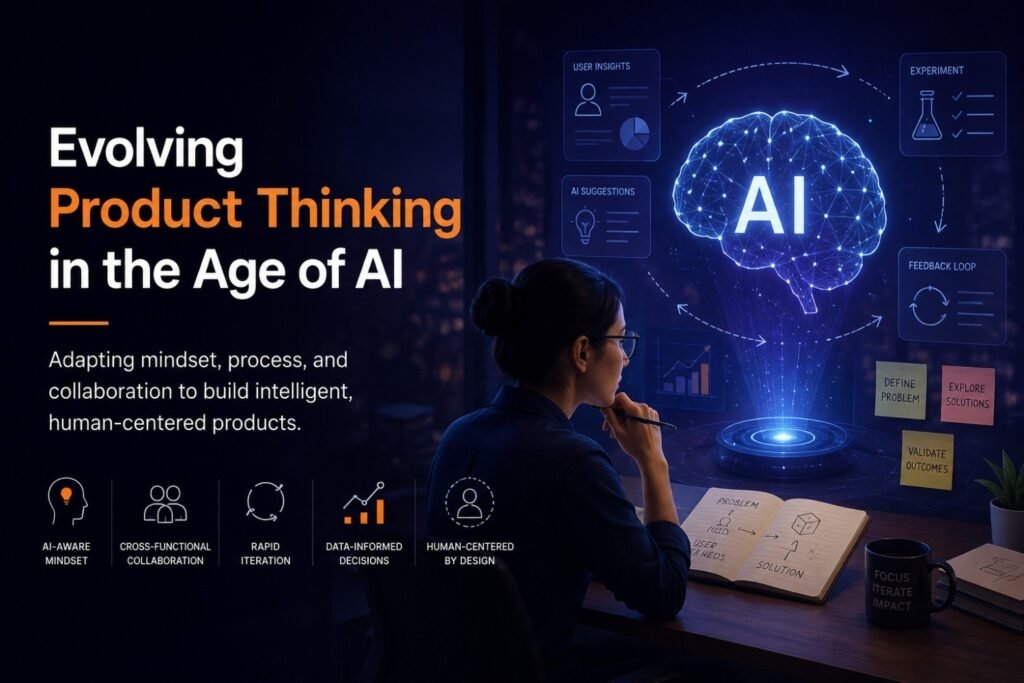
For product managers who have built across the full lifecycle: ideation, development, launch, and iteration - the rise of AI introduces a new kind of complexity. It’s no longer just about shipping features; it’s about shaping systems that learn, adapt, and sometimes behave unpredictably.
Traditionally, strengths in product management have included:
- Deep problem discovery and strategic thinking
- Cross-functional execution across teams
- Driving go-to-market and adoption
- Continuous iteration and improvement
But AI shifts expectations in fundamental ways:
- Iteration cycles become significantly faster
- Products move from reactive to predictive
- Behavior becomes probabilistic rather than deterministic
- Experimentation becomes continuous, not occasional
This isn’t just a shift in tools-it’s a shift in thinking.
The Shift in Approach
Adapting to AI-first product development starts with a mindset shift: from building products to continuously learning how to build them.
This shift is grounded in a few key principles:
1. Problem first, not AI first
AI is a capability, not a starting point. The focus remains on identifying meaningful user problems before deciding whether AI is the right solution.
2. Building AI literacy
Understanding the fundamentals - large language models, prompt design, and data dependencies becomes essential. Not to become an engineer, but to make better product decisions.
3. From requirements to hypotheses
Instead of fixed specifications, product decisions are framed as experiments:
- What do we expect the model to do?
- How will we evaluate success?
- What happens when it fails?
4. Designing for human-in-the-loop
AI systems are powerful but imperfect. Incorporating user control and intervention ensures reliability and builds trust.
5. Continuous learning through feedback
AI products are never “done.” They improve through real-world usage, feedback loops, and ongoing refinement.
This approach treats AI not as a feature to be shipped, but as a system to be shaped over time.
Execution in Practice
The transition to AI-aware product thinking isn’t theoretical - it’s deeply practical.
It shows up in how products are built day-to-day:
- Product flows are redesigned to include AI-assisted decision points
- Collaboration with engineering and data teams becomes more tightly integrated, especially around feasibility and trade-offs
- Rapid prototyping replaces long planning cycles
- Feedback loops are embedded directly into the product experience
- Automation is balanced with user control to maintain usability and trust
Execution becomes less about delivering a perfect version and more about iterating toward a better one.
In a Nutshell
This shift doesn’t just change how products are built - it improves what they can become.
- Faster iteration cycles enable continuous improvement
- Products become more adaptive to user behavior and needs
- Decision-making is enhanced through AI-assisted workflows
- Alignment between product, engineering, and data teams strengthens
- Teams develop a sharper ability to distinguish meaningful AI use cases from superficial ones
Most importantly, it allows product managers to evolve from executing roadmaps to shaping intelligent systems.
Closing Thoughts
AI doesn’t replace product thinking, it expands it.
The real advantage lies with those who can combine first-principles product thinking with an understanding of emerging AI capabilities. Because in this new landscape, success isn’t defined by who uses AI, but by who uses it with intent.
The goal is not to become an AI expert.
It’s to become an AI-aware product thinker - one who can navigate ambiguity, experiment with purpose, and still deliver meaningful outcomes.
Ready for your next Product Development?
Talk to the DREO solutions team about AI assisted Product Management and what it takes to ship with confidence.
Book a Consultation